| |
 | BUBU ;-) | |  ¿Andandará la meta?
 Grupo: Moderadores generalesMensajes: 3513 Status:  | |
| Ay, paaayo, arguien que me diga las medidas de sus telercoooopios.... |
| |
| Quark | |  El poder de la Quantica
 Grupo: MemberMensajes: 5658 Location: Valencia Status: | |
| Aaaayyy Josele, yo tenia uno d esos que miras por un lao y se ve mas grande que cuando miras por el otro lao  uno d esos de 900mm chatarreros pero er tripode tenia un autostar y me molaba mushoooo, me pire a madrid a vivir y pa pagar la fragoneta tuve que venderlo, to una lastima josele. Pa habernos matao  |
| |
| BUBU ;-) | | ¿Andandará la meta?
Grupo: Moderadores generalesMensajes: 3513 Status: | |
| Ja me maaaaaaaaaaaten |
| |
| Quark | | El poder de la Quantica
Grupo: MemberMensajes: 5658 Location: Valencia Status: | |
| Hoy a las 11.30 am sabremos si los de la ESA son competentes |
| |
| BUBU ;-) | | ¿Andandará la meta?
Grupo: Moderadores generalesMensajes: 3513 Status: | |
| Como se hayan equivocado los capullos estos otra vez con lo de km y millas..., o como no hayan tenido en cuenta el efecto de Coriolis... |
| |
| Jandrez | | Marciano
Grupo: MemberMensajes: 158 Status: | |
| Venga Quark, que ya falta poco 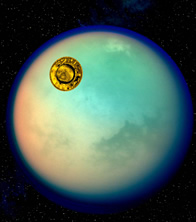 No te comas todas las uñas, que luego duelen al jugar al Track & Field |
| |
| Quark | | El poder de la Quantica
Grupo: MemberMensajes: 5658 Location: Valencia Status: | |
| 6.51 Timer triggers power-up of onboard electronics
Triggered by a pre-set timer, Huygens's onboard electronics power up and the transmitter is set into low-power mode, awaiting the start of transmission.
11.13 Huygens reaches 'interface altitude'
The 'interface altitude' is defined as 1270 kilometres above the surface of the moon where entry into Titan's atmosphere takes place.
11.17 Pilot parachute deploys
The parachute deploys when Huygens detects that it has slowed to 400 metres per second, at about 180 kilometres above Titan's surface. The pilot parachute is the probe's smallest, only 2.6 metres in diameter. Its sole purpose is to pull off the probe's rear cover, which protected Huygens from the frictional heat of entry.
2.5 seconds after the pilot parachute is deployed, the rear cover is released and the pilot parachute is pulled away. The main parachute, which is 8.3 metres in diameter, unfurls.
11.18 Huygens begins transmitting to Cassini and front shield released
At about 160 kilometres above the surface, the front shield is released.
42 seconds after the pilot parachute is deployed, inlet ports are opened up for the Gas Chromatograph Mass Spectrometer and Aerosol Collector Pyrolyser instruments, and booms are extended to expose the Huygens Atmospheric Structure Instruments.
The Descent Imager/Spectral Radiometer will capture its first panorama, and it will continue capturing images and spectral data throughout the descent. The Surface Science Package will also be switched on, measuring atmospheric properties.
11.32 Main parachute separates and drogue parachute deploys
The drogue parachute is 3 metres in diameter. At this level in the atmosphere, about 125 kilometres in altitude, the large main parachute would slow Huygens down so much that the batteries would not last for the entire descent to the surface. The drogue parachute will allow it to descend at the right pace to gather the maximum amount of data.
11.49 Surface proximity sensor activated
Until this point, all of Huygens's actions have been based on clock timers. At a height of 60 kilometres, it will be able to detect its own altitude using a pair of radar altimeters, which will be able to measure the exact distance to the surface. The probe will constantly monitor its spin rate and altitude and feed this information to the science instruments. All times after this are approximate.
12.57 Gas Chromatograph Mass Spectrometer begins sampling atmosphere
This is the last of Huygens's instruments to be activated fully. The descent is expected to take 137 minutes in total, plus or minus 15 minutes. Throughout its descent, the spacecraft will continue to spin at a rate of between 1 and 20 rotations per minute, allowing the camera and other instruments to see the entire panorama around the descending spacecraft.
13.30 Descent Imager/Spectral Radiometer lamp turned on
Close to the surface, Huygens's camera instrument will turn on a light. The light is particularly important for the 'Spectral Radiometer' part of the instrument to determine the composition of Titan's surface accurately.
13.34 Surface touchdown
This time may vary by plus or minus 15 minutes depending on how Titan's atmosphere and winds affect Huygens's parachuting descent. Huygens will hit the surface at a speed of 5-6 metres per second. Huygens could land on a hard surface of rock or ice or possibly land on an ethane sea. In either case, Huygens's Surface Science Package is designed to capture every piece of information about the surface that can be determined in the three remaining minutes that Huygens is designed to survive after landing.
15.44 Cassini stops collecting data
Huygens's landing site drops below Titan's horizon as seen by Cassini and the orbiter stops collecting data. Cassini will listen for Huygens's signal as long as there is the slightest possibility that it can be detected. Once Huygens's landing site disappears below the horizon, there's no more chance of signal, and Huygens's work is finished.
16.14 First data sent to Earth
Cassini first turns its high-gain antenna to point towards Earth and then sends the first packet of data.
Getting data from Cassini to Earth is now routine, but for the Huygens mission, additional safeguards are put in place to make sure that none of Huygens's data are lost. Giant radio antennas around the world will listen for Cassini as the orbiter relays repeated copies of Huygens data. |
| |
| BUBU ;-) | | ¿Andandará la meta?
Grupo: Moderadores generalesMensajes: 3513 Status: | |
| Jiji, pero eso es lo que está previsto, Quark, veremos a ver si se cumple... |
| |
| Quark | | El poder de la Quantica
Grupo: MemberMensajes: 5658 Location: Valencia Status: | |
| uf, no se...  |
| |
| Quark | | El poder de la Quantica
Grupo: MemberMensajes: 5658 Location: Valencia Status: | |
| De momento han acertado de lleno  |
| |
| Quark | | El poder de la Quantica
Grupo: MemberMensajes: 5658 Location: Valencia Status: | |
| Weeeenoooo todo un exito  habra vida en titan??? |
| |
| chaterer | | | A ver si saca alguien ahora la manera de hacerse un telescopio con aglomerado y cristales invertidos etc  juasjuas Ya estoy viendo el tutorial El Teleskopio de ... (a mi me gusta tambien pero no dispongo de ello) | | | |
| |
| BUBU ;-) | | ¿Andandará la meta?
Grupo: Moderadores generalesMensajes: 3513 Status: | |
| No sé por qué, pero tengo la pesimista sensación de que ahí no habrá ni el más mínimo atisbo de vida, ni siquiera bacteriana. Y que yo estoy seguro que no llegaré a verlo...
Es que yo los descubrimientos tan fantásticos que ocurren de un día para otro no me las creo... Ya sé que estoy siendo anticarlsaganiano, pero es lo que siento, para mi desgracia... |
| |
| Quark | | El poder de la Quantica
Grupo: MemberMensajes: 5658 Location: Valencia Status: | |
| Carl Sagan es un dios pa mi, no te metas con el que te doy con el palo del dolor |
| |
| 45 respuesta(s) desde el 1/1/2005, 23:48 |
| | | | |
|


